
Vince Gilligan is the master of the slow burn. Rewatching the showrunner’s debut now, one is startled to find that Breaking Bad (2008-2013) is rather dull until episode six, when chemist-turned-meth-kingpin Walter White nearly blows up a rival with a clump of fulminated mercury. Better Call Saul (2015-2022), in retrospect an even finer series, spends at least a season clearing its throat. That both shows are masterpieces by the end is hardly worth debating: Gilligan could lay down his pen tomorrow and retire as one of the three or four best television creators ever. Fortunately for viewers, the writer-director is doing no such thing, and his latest production bursts from the starting gate like a champion thoroughbred.
That show, the patriotically named Pluribus, is now streaming on Apple TV and has already been renewed for a second season. Starring Better Call Saul’s Rhea Seehorn, the series asks whether a capacity for misery is at the heart of our identity as human beings. Intrigued, like Gilligan’s previous productions, by smashed-up genre tropes, Pluribus reconceives sci-fi’s alien-virus plot as a happiness disease, a mass cerebral rewiring that leaves victims satisfied, smiling, and dull. One minute, the Earth’s citizens are pursuing their destinies in raucous, competitive disunity. The next, we are all members of a boringly contented hive mind.
Seehorn plays Carol Sturka, a misanthropic “romantasy” novelist and one of 13 virus-resistant people on the planet. Out with her partner, Helen (Miriam Shor), one evening, Carol notices aircraft dumping chemtrails overhead, a curiosity that leads, moments later, to Helen’s death and that of nearly a billion people worldwide. Those who survive are not just changed but erased, shorn of their individuality and reborn as interchangeable parts of a whole. Justly distraught, Carol makes her way home, only to learn that the hive’s scientists are already hard at work on overriding her immunity.
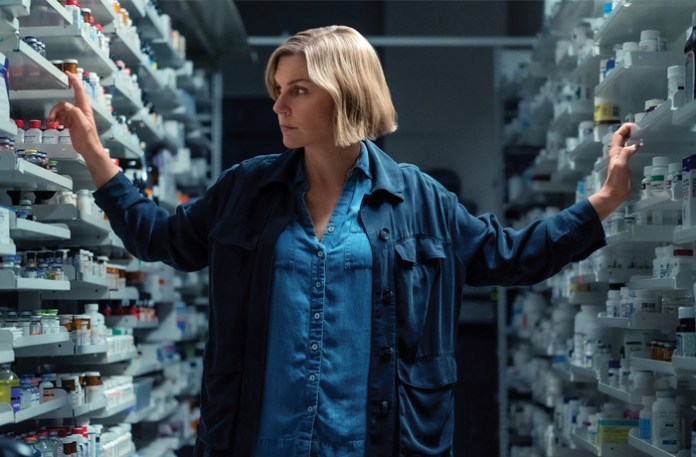
What are we to make of so obviously COVID-19-themed a fable? On the one hand, Gilligan has sworn that the show’s pandemic echoes are mere coincidence, the plot having occurred to him more than a decade ago. On the other, the series rewrites humanity via the same mRNA technology that powered the Pfizer vaccine. No, Pluribus is not, or not only, an anti-vaxxer’s entertainment dream come true, but don’t tell me its creator didn’t know what he was doing. As the last sane person in America, Carol must mourn not only Helen but the willful dismantling of society. Outside the gates, fanatics crouch, demanding our heroine’s compliance for her own good.
Of course, it is possible to watch and love Pluribus even if one is on their fifth vaccine “booster.” Such is the power of Gilligan’s world-building that the fiercest pharma devotees alive will struggle to turn the dial. Pathologically committed to niceness, the men and women surrounding Carol can’t lie, do violence, or deny even insane requests. Because they share a consciousness, they all know everything, from the provenance of a particular water bottle to what your “third-grade teacher’s husband’s sister” was once thinking.
These “rules” make for some highly amusing television. Determined to wrong-foot her handler, Zosia (Karolina Wydra), Carol asks for a grenade and receives one, to explosive effect. The child of a fellow exemptee is now also “[her] prime minister, some guy [she] dated in high school, and [her] gynecologist,” as Carol gleefully points out during a survivors’ meet-and-greet. Much of the series’s fun lies in watching how those unaffected by “the Joining” respond to the new civility code. For Koumba Diabaté (Samba Schutte), a devilishly charming Mauritanian, the sudden pliability of Earth’s women is an occasion to set up a harem and head for Las Vegas. Manousos Oviedo (Carlos-Manuel Vesga), meanwhile, would rather eat dog food in his Paraguayan trailer than accept gifts from the hive.
For narrative reasons, if for no other, Carol’s behavior falls somewhere between these two extremes. Warily emerging from seclusion, our protagonist begins to understand the impulses that drive her unyieldingly friendly foes. By the fourth episode, she has hatched a plot to reverse humanity’s zombification and set the world to rights. Or do I mean “to wrongs”? More than a little impishly, the season’s middle installments leave open the possibility that Carol is foolish to want to restore society’s previous disorder. “We know what it feels like to be you,” a not unpersuasive Zosia tells Carol. “We’ve been you. But you’ve never been us.”
Undoubtedly, some viewers will see Pluribus not as a pandemic tale but as a send-up of Trumpism or the unwashed Evangelical masses. Others, recalling the Beijing Olympics Opening Ceremony, will behold the hive’s synchronization with a geopolitical shudder. I might argue that a show about the creepiness of the collective is inherently conservative, dedicated to the proposition that we are, and of right ought to be, free and independent. Yet the hive’s quasi-socialist setup sure seems to work well. “As we speak, no one is being robbed or murdered,” Koumba reminds Carol. “No one is in prison. The color of one’s skin, by all accounts, [is] now meaningless.” It would appear, in other words, that the central economic fact, scarcity, is operative only if we’re quarrelling with one another. In the absence of malice, there really is enough to go around.
Poppycock, of course, and I expect Pluribus to poke a hundred holes in that theory before its first season is done. In the meantime, Gilligan remains the most technically thrilling showrunner currently going, as adept behind the camera as he is with a pencil and pad. Has any series creator ever been as comfortable with long silences, seeming incongruities, or plot elements that only appear to go nowhere? Has anyone ever repaid audiences’ trust and patience more generously? Watching the eight-minute wordless sequence with which episode four begins, I was in TV heaven: absorbed, bewildered, and fully confident that all would be made clear. No, scratch that, I was there the whole time. Stop what you’re doing and watch Pluribus today. It’s that good.
Graham Hillard is editor at the James G. Martin Center for Academic Renewal and a Washington Examiner magazine contributing writer.