
Despite months of opposition to key points of President Donald Trump‘s international Board of Peace, Israel has officially joined the club.
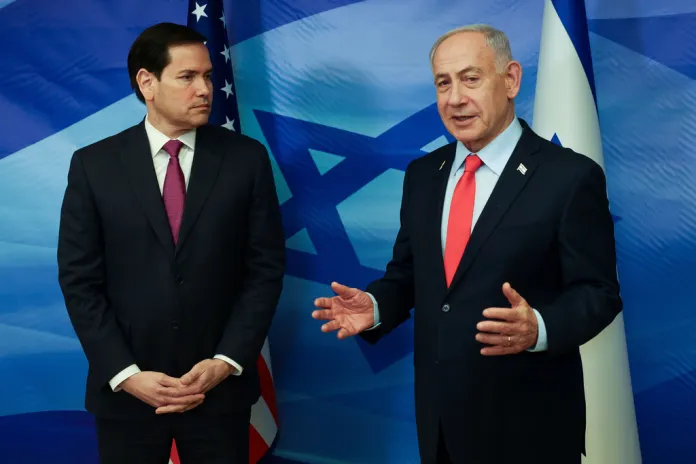
Israeli Prime Minister Benjamin Netanyahu signed Israel’s agreement with the international body on Wednesday during a meeting with Secretary of State Marco Rubio. The pair posed for a photo with the documents formalizing Israel’s place in the international body.
The signing took place at Blair House, the White House’s official guest residence, ahead of Netanyahu’s meeting with Trump later in the day.
Israeli participation on the board was not a given due to fierce opposition to the proposed body in the Knesset, with right-wing members saying Turkey and Qatar’s participation would undermine Israeli interests in the reconstruction of Gaza.
“Trump has figured out your operating mechanism,” Opposition leader Yair Lapid told Netanyahu last month. “If he invites you to a party, with a few nice words and a big hug in front of the cameras, he can fold you on the most vital security interests of the State of Israel.”
Netanyahu voiced skepticism toward Trump’s board just last month, when he said the structure of the body’s “executive board” was “not coordinated with Israel and runs contrary to its policy.”
The prime minister’s position could have softened after seeing a draft resolution outlining the powers of the board’s various bodies, which Israeli media said offered Turkey and Qatar far less power than previously believed.
Netanyahu announced his intention to join the board on Jan. 21.
However, not everyone is excited for the Board of Peace. On the same day that Netanyahu formalized Israeli participation at Blair House, Poland declined to join.
“Taking into account certain national doubts regarding the shape of the board, under these circumstances, Poland will not join the work of the Board of Peace, but we will analyze it,” Polish President Donald Tusk announced on Wednesday.
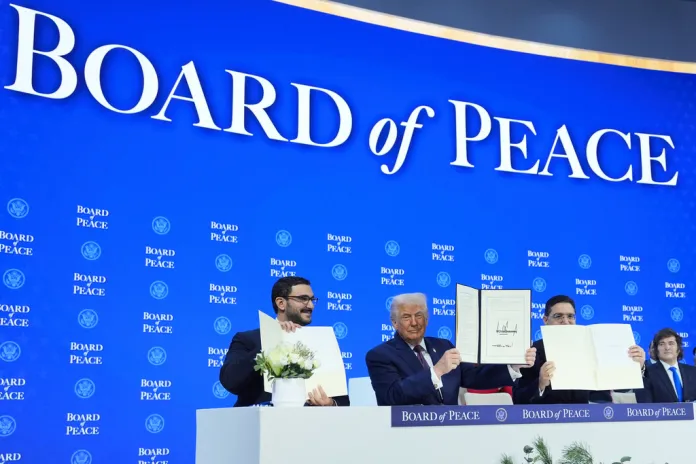
Netanyahu and Trump are expected to discuss the future of U.S.-Israeli cooperation on military support and security during their meeting on Wednesday, as well as the future of Iran.
The Israeli leader is seeking to “taper” off his nation’s reliance on U.S military aid over the coming decade, a proposal that seems to fit well within the White House’s “America First” agenda.
Netanyahu is also expected to press Trump toward a more aggressive posture concerning Iran, which is still attempting to stabilize after weeks of protests threatened the sovereignty of the Islamic regime.
The United States has demanded that Iran cease all nuclear enrichment, not buying the regime’s claims that its enrichment program is strictly concerned with civil energy development.
“Our country, Iran, will not yield to their excessive demands,” Iranian President Masoud Pezeshkian said during a speech at Azadi Square on Wednesday. “Our Iran will not yield in the face of aggression, but we are continuing dialogue with all our strength with neighboring countries in order to establish peace and tranquility in the region.”
IRAN, GAZA, AND ENDING MILITARY AID TO ISRAEL HANG OVER TRUMP AND NETANYAHU MEETING
Pezeshkian reaffirmed the regime’s position that it is “not seeking to acquire nuclear weapons” and said Iran is “ready for any verification” demanded of it.
Israel is seeking further restrictions on Iran’s ballistic missile infrastructure and its cooperation with ideologically aligned proxy groups across the Middle East.