
Ukraine views the U.S. war in Iran as an extension of its war against Russia, even though it doesn’t seem like President Donald Trump and his administration agree.
From their perspective, Iran’s assistance to Russia through the war, and Russia’s reciprocal assistance back demonstrates that they are on the same side of this broad wide-reaching conflict, which put the U.S. and Ukraine on the same side.
“It is my hope that Ukrainian expertise and practical experience will be seen as a valuable asset for protecting American lives. I view the conflict in Iran and Ukraine’s struggle against Russia as two fronts of the same war,” Captain Max Maslii, Deputy Chief of Staff of the Ukrainian Air Force’s 96th Anti-Aircraft Missile Brigade, told the Washington Examiner.
“The collaboration between Russia and Iran poses a direct threat to Ukraine, as evidenced by the transfer of Shahed production technology to Russia. Reports also suggest that Iran has explored providing ballistic missiles for use against Ukraine, though this has fortunately not yet materialized
“The delivery has been postponed because Iran is currently occupied with own problems which has diverted their focus from transferring missiles to Russia for use against Ukrainian civilians.”
Ukrainian President Volodymyr Zelensky has dispatched more than 200 drone operators to the Middle East to help the U.S., Israel, and Gulf countries adequately defend against Iranian drones. Ukraine has more experience defending against these drones than any other country on the planet — a valuable skill set considering Iran’s close military relationship with Russia.
“Ukraine has consistently remained open to sharing its training, technology, and battlefield expertise with our allies, especially the United States,” he added. “The proposal we put forward following the start of the Iran operation is consistent with what has been offered previously.”

The Ukrainian military was forced to learn the art of drone warfare quickly after Russia launched its invasion in early 2022. In the years since the conflict began, it has become the undisputed authority on weapons such as unmanned aerial systems (UAS) and unmanned aerial vehicles (UAV).
Following the United States’ launch of Operation Epic Fury late last month, Iran deployed its own armada of light-weight, low-cost attack drones. The Islamic Republic’s counter-attack was scattershot — striking not only U.S. bases but also indiscriminately detonating at residential and commercial buildings throughout the Middle East.
Ukraine has little in the way of extra munitions to lend the U.S. and its regional allies in the Gulf, but Kyiv’s mobilization of anti-drone experts could lend cutting-edge consultation on how to protect civilians and neutralize the increasingly desperate Iranian regime’s attacks.
Maslii told the Washington Examiner that despite their own defensive war, Ukrainians remain “highly capable of assisting our partners through training and technology sharing,” and can offer material support through their “increasingly scalable production infrastructure.”
“We can facilitate the shipment of various drones, including interceptor models,” he explained.
The U.S. has used significantly more sophisticated and expensive air defense systems to defend against the Iranian drones, though the math does not work out in the U.S.’s favor — using missiles that cost hundreds of thousands, if not millions of dollars, to shoot down drones that cost tens of thousands of dollars to produce. Ukraine has figured out innovations to use less expensive systems to shoot down incoming drones.
There has also been reporting that Russia has provided Iran with intelligence to target U.S. troops and bases in their retaliatory operations, even though the White House has downplayed the implications of it.
“It clearly is not making a difference with respect to the military operations in Iran because we are completely decimating them,” White House press secretary Karoline Leavitt said on March 6. “As I said earlier, we’ve taken out nearly 30 of their ships. Their navy has been deemed combat ineffective. 90% reduction in ballistic missile retaliatory strikes against the United States and our Gulf, Arab, and partners in the region.”
However, Iranian operations have resulted in the deaths of seven U.S. troops, while six others were killed in a non-combat KC-135 crash in Iraq. More than 300 troops have been wounded as well, the vast majority of whom suffered minor injuries and have since returned to duty, a CENTCOM spokesperson told the Washington Examiner.
‘Last person we need help from’
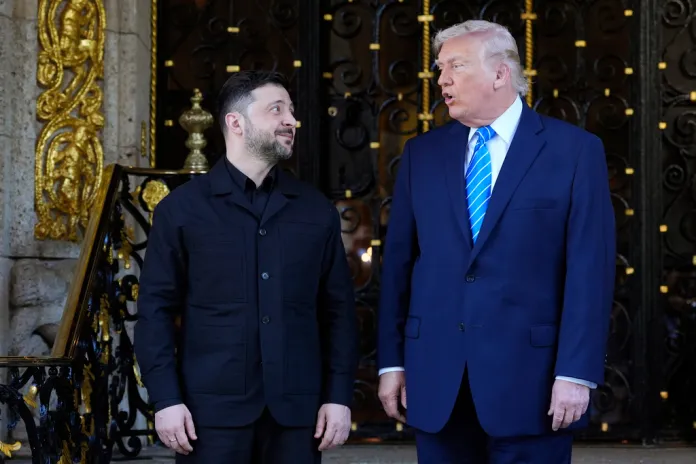
Despite that experience and capacity for scaled production, Trump recently denigrated Ukraine’s offer, saying the “last person we need help from is Zelensky.” The two leaders have a famously combustible relationship.
It’s a frustrating dismissal, considering the unique opportunity for Ukraine to reverse roles from relying on U.S. aid to providing support for a war unpopular with the White House’s allies.
The tension between the two countries was laid bare this week, when Zelensky claimed the U.S. would only offer security guarantees if they gave up the Donbas region, an area that Russia and Ukraine have fought over since 2014. Secretary of State Marco Rubio said on Friday, “that’s a lie,” adding, “I don’t know why he says these things, they’re just not true.”
Kurt Volker, the former U.S. ambassador to NATO, told the Washington Examiner: “I think they also they want to show goodwill to the U.S., because the U.S. has done a lot for Ukraine,” adding that Ukraine is looking to show “they’re not hopeless or helpless, they’re capable in their own right, and they can help us.”
Ukraine, he said, believes that it and the U.S. are fighting on the same side of a much larger conflict in which Russia and Iran are on the same side.
“You have Russia supplying intelligence to Iran, North Korea, sometimes troops, sometimes artillery, shells to Russia. You have Iranian drones going to Russia to attack Ukraine, and then you have Russia sending modified drones back to Iran to attack U.S. forces,” he said. “And if we don’t see this as all connected, we actually inadvertently strengthen our adversaries, as I mentioned, by allowing Russia to sell gas, sell oil, and make money.”
Simultaneously, in an effort to help ease the energy burden caused by Iran’s closure of the Strait of Hormuz, the Trump administration moved to loosen sanctions on Russian oil earlier this month. The move, however, was heavily criticized by European allies, who claim it will only fuel Russia’s campaign in Ukraine by giving them newfound revenue.
Trump rebukes NATO for lack of support
Trump’s decision to snub Ukraine’s offers is all the more baffling due to his inability to rally fellow NATO members such as the nations of Western Europe to aid Operation Epic Fury.
The president has routinely complained that NATO allies haven’t helped the U.S. in the war in Iran —though many European leaders were not aware it would happen ahead of time — and has subsequently criticized members of the alliance for not entering the conflict.
“Without the U.S.A., NATO IS A PAPER TIGER! They didn’t want to join the fight to stop a Nuclear Powered Iran,” he said on social media last week. “Now that fight is Militarily WON, with very little danger for them, they complain about the high oil prices they are forced to pay, but don’t want to help open the Strait of Hormuz, a simple military maneuver that is the single reason for the high oil prices.”
His criticisms of the alliance are not new. He has long argued for the alliance to do more to build up their own defenses, and allies have listened, though some of the spending increase predates his second term and came in response to Russia’s invasion of Ukraine in 2022.
In a NATO report released this week, every member of the alliance reached the goal for the first time set in 2014 of spending 2% of their gross domestic product (GDP) on defense.
The U.S. allocated an estimated $838 billion on defense spending in 2025, whereas the European allies and Canada spent $574 billion. In 2024, under President Joe Biden, the U.S. allocated $850 billion in defense spending, whereas NATO, Europe, and Canada spent $480 billion.
Maslii speculated that military officials might be slow to take up Ukraine’s offer as they conduct a “comprehensive analysis from various perspectives to identify the optimal path forward.”
US PUSHING UKRAINE TO GIVE UP DONBAS FOR SECURITY GUARANTEES IN NEGOTIATIONS, ZELENSKY SAYS
He explained: “This deep level of scrutiny may explain why we are seeing a range of opinions across different levels of government that, at times, appear to be at odds with one another.
Trump continues to insist that the Islamic Republic is close to capitulating in negotiations with the White House, but refuses to provide details of the talks.