
When Rabbi Jacob Schacter visited the Normandy American Cemetery in 2014, one detail stayed with him long after his return home.
The observation seemed insignificant at first. But for Schacter and the historians and genealogists who would later found Operation Benjamin, it raised a troubling question: Why did there appear to be so few Jewish grave markers among the thousands of American soldiers buried overseas?
“It was hallowed and profound,” he later recalled. “But I thought there would have been more Stars of David.”
The answer, they would eventually discover, was that some Jewish American servicemen killed during World War I and World War II were buried under crosses instead of a Jewish Star of David.
Now, decades later, Operation Benjamin is working to correct those headstones and restore the identities of fallen soldiers buried under the wrong markers.
“Our main task is justice and memory,” Shalom Lamm, co-founder and chief historian at Operation Benjamin, told the Washington Examiner. “A soldier gave his life for our country and then lost his ability to fight for his own identity.”
Operation Benjamin, a nonprofit organization, works with the American Battle Monuments Commission, the federal agency that oversees U.S. military cemeteries abroad, to investigate and verify cases and change headstones for American soldiers buried under the wrong marker.
Benjamin Garadetsky’s story
The effort began, in Lamm’s words, “serendipitously.”
After Schacter returned from Normandy and told Lamm there seemed to be fewer Stars of David than expected, they began to investigate. Roughly 2.7% of American World War II casualties were Jewish, according to Lamm, which suggested there should have been more Jewish markers among the nearly 9,400 graves at the Normandy American Cemetery. Instead, Lamm and Schacter counted fewer than 150.
Their investigation led them to one soldier, Benjamin Garadetsky, whom the organization would later name itself after.
“It was almost like throwing a dart,” Lamm said. “We picked a soldier with a Jewish-sounding name … and his name was Benjamin Garadetsky.”
Garadetsky was born in Ukraine and was raised in the Bronx in a Jewish immigrant family. Yet, he had a “P” for Protestant on his dog tag.
This error, though, was not uncommon during World War II.
“Tens of thousands of Jewish soldiers put P’s and C’s for Catholic and Protestant on their dog tags in case they were captured by the Germans,” Lamm said. “They didn’t want to be identified as Jews.”
Battlefield burial teams relied on a soldier’s dog tags when making burial decisions during the war. Soldiers in the European theater were often buried several times before reaching their final resting place, allowing initial mistakes to follow them to their permanent resting spot.
Travel to Europe after the war was expensive and difficult, particularly for immigrant families whose relatives were buried overseas, so many never knew their son’s, father’s, or husband’s graves were marked incorrectly.
“It would have devastated the family,” Lamm said. “But they really never knew.”
The mission to restore identity
Correcting those mistakes requires years of historical and genealogical research.
Operation Benjamin’s team reconstructs family histories using census documents, synagogue records, military files, cemetery records, and newspaper archives. Researchers trace family continuity across generations to establish evidence of Jewish identity before presenting findings to the government and surviving relatives.
The research can involve tracing great-grandparents through European cemeteries, locating synagogue bulletins documenting marriages or bar mitzvahs, or examining newspaper obituaries for references to Jewish mourning traditions such as shiva. Researchers also rely on census records showing languages spoken at home, military records from relatives, and immigration documents.
The organization now employs teams of historians and genealogists focused separately on World War I and World War II cases, whom Lamm called “serious professionals.”
The American Battle Monuments Commission requires extensive documentation before approving any headstone changes. Lamm said the agency has become one of Operation Benjamin’s strongest partners. “I thought there’d be a fight,” he said. “I could not have been more wrong.”
Instead, he said the government established a rigorous evidentiary standard requiring the investigators to locate the closest living relatives of each soldier. Researchers typically avoid contacting families until most of the investigation is already complete, to avoid causing unnecessary distress or raising false hopes. If multiple relatives exist at the same level of relation, researchers must contact all of them. At least one relative must advocate the change, and none can object. Only then can a request move forward.
Lamm said one of the most emotional parts of the work has been reconnecting families with relatives they barely knew.
In many cases, the fallen soldiers existed within families only as faded photographs or names that older generations rarely discussed. Researchers often arrive with information that descendants had never heard before, such as military records, school activities, career ambitions, and even the names of relatives separated across generations.
“We take this faded photograph, and we bring a guy to life,” Lamm said. “He was a real person with real aspirations.”
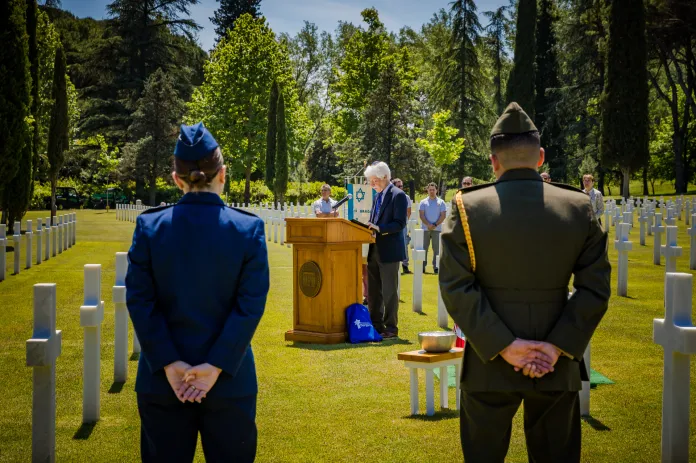
In some cases, relatives meeting through the research process have connected for the first time. At a recent ceremony in Italy, family members who had never known each other met at a corrected headstone ceremony and stayed in contact afterward.
“It’s mind-boggling when that happens,” he said.
Honoring World War I soldiers at Meuse-Argonne
Operation Benjamin has now completed 40 headstone replacements and has dozens more scheduled over the next 15 months.
One of its largest ceremonies will take place in France in early June, where five Jewish American soldiers killed during World War I’s Meuse-Argonne Offensive will receive corrected headstones more than a century after their deaths.
The Meuse-Argonne campaign, fought in the final months of World War I, remains the deadliest battle in American military history.
The ceremony will take place at the Meuse-Argonne American Cemetery, the largest American World War I cemetery in Europe, where more than 4,000 U.S. service members are buried.
Families of several soldiers are expected to travel from the United States, Israel, and Greece for the event, alongside representatives from the U.S., German, and Israeli governments.
The following day, Operation Benjamin plans to participate in a separate ceremony honoring German Jewish soldiers buried beneath incorrect markers in a nearby German military cemetery. For Lamm, the symbolism of the two ceremonies occurring together is difficult to ignore.
“This is a staggering historic event,” he said. “What’s bringing people together now is Jewish soldiers.”
The event will include students from the Virginia Military Institute, Yeshiva University, and Germany’s Bundeswehr University in Munich, part of what organizers describe as an effort to teach younger generations about memory, sacrifice, and historical responsibility.
“We’re bringing together genuinely good people,” Lamm said. “People history would have told you would never meet.”
Remember Jewish American soldiers on Memorial Day
The work, he said, feels especially significant around Memorial Day, when Americans reflect on military sacrifice and the cost of war. “Freedom isn’t free,” he said, adding that war is a “terrible thing.”
For Operation Benjamin’s founders, the work is ultimately about restoring truth to soldiers who can no longer speak for themselves. “We could never repay this debt,” Lamm said. “But to the extent we can help them reestablish their identity, it matters.”
“I personally believe these guys know we’re doing this,” he said, adding that whether that can be proven does not seem to matter much to the families who stand beside the corrected headstones.
TOM ROGAN: AMERICA HAS DONE MORE FOR HUMAN FREEDOM THAN ANY POWER IN HISTORY
What matters is that, decades after their deaths, the soldiers are finally being remembered as they were.
“We, as a society that demands truth,” Lamm said, “should do no less.”