
Andy Serkis and Jonathan Cavendish, Animal Farm director and Imaginarium Studios business partner, respectively, pushed back against critics who have said their animated film was anti-capitalist.
“I love criticism — if it’s constructive and interesting,” Cavendish said to a room full of journalists having lunch Thursday.
“There’s a huge triumph of capitalism centrally in the story where the animals have taken over the farm, and they need money, because otherwise the farm is going to get repossessed. So they start a farmers’ market, and it’s a massive success. How can this be a criticism of capitalism?” Cavendish said.
Animal Farm is an adaptation of George Orwell’s 1945 novella by the same name, whose allegorical retelling of the 1917 Russian Revolution and its aftereffects has remained poignantly relevant over the years.
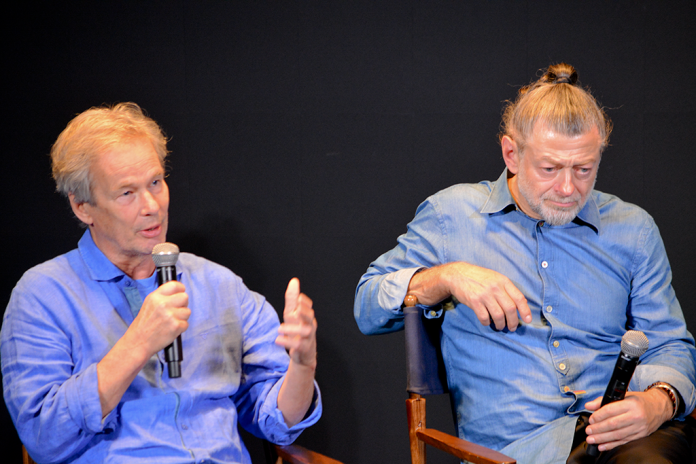
In Serkis’s own words: “We aimed to tell this story examining contemporary themes and references without being in any way partisan. Absolute power corrupts absolutely, no matter who is in charge.”
His film remains true to this, with the inclusion of new, nongovernmental threats for the farm, such as technology (drones, cellphones), leaders of tech and industry, and even banking, more specifically, credit cards.
Nonetheless, what Serkis and Cavendish made abundantly clear during the luncheon was this: Their goal was to spark intergenerational debate, no matter where you stand.
“What we wanted to do, we achieved,” Cavendish said, “to make a film that causes a huge amount of debate.”
According to Serkis, there were 60 million hits criticizing “a film they haven’t even seen,” just criticisms from a “30 seconds or a minute of a trailer.”
Cavendish backed him, “The dream was to get 60 million people three months before the film comes out to watch the trailer in 24 hours. That doesn’t happen. No film probably ever was like that before. The fact that most of the people who watched it then had a nervous breakdown or heart attack. You know, what do you do?”
OPINION: HOLLYWOOD BUTCHERS ANIMAL FARM
The filmmakers worked very closely with the Orwell estate, which was represented by a man whose father was best friends with Orwell, to make their adaptation as close to what Orwell would’ve wanted if he were alive today. Throughout his life, Orwell was an ecologist and farmer, so his decision to use animals as characters was very intentional: He wanted to write a book that would appeal to young people, while also underscoring man’s threat to nature.
In this sense, Orwell’s novella was prophetic, as Cavendish points out during a fireside chat led by journalist and CNN commentator Scott Jennings. “He [Orwell] never really proposed anything. He just criticized a lot of things, which is both easier and contains more truths,” Cavendish said.
And in watching how nature was getting destroyed by mankind during his own time, the filmmakers honored Orwell by updating an antagonist to be a super eco-farmer (Pilkington) — something they think Orwell would’ve been terrified by. They also maintained Orwell’s simple but resoundingly principled approach by making their film politically nonpartisan and culturally nonspecific.
They’ve succeeded. Conservative critics have bemoaned the anti-capitalistic elements, accusing the filmmakers of straying too far from an anti-communist book, and liberal critics have said they didn’t stray far enough into anti-fascism.
OPINION: ANIMAL FARM MOVIE: IRKING BOTH SIDES
Jennings was “fascinated by how they did that,” and elaborated on his thoughts on the propaganda, fake news, and misinformation aspects of the film to the Washington Examiner.
“Part of what I do on CNN and in all my jobs is I try to reframe things, put things back on the rails, try to explain to the audience the difference between narrative and reality, the difference between propaganda and truth. … I’ve certainly gotten into debates with people who can’t tell the difference, or who are so committed to some sort of narrative or alternate reality that they’re sort of shocked when I say this didn’t happen.”
Jennings cited one recent “crazy” example: “The great lobster hoax of 2026, when all the Democrats had convinced themselves that Pete Hegseth had bought $10 million worth of lobster to personally eat, and it … made it to the debating table on CNN. I feel like that happens all the time, and so I’m anxious to see how they [filmmakers] treated the movie. But I actually think part of my job in this world is to try to bring forward true things in a world that seems to be constantly attracted to propaganda, attracted to narratives, attracted to alternate realities.”
“I’m shocked, honestly, at the reality that some people construct for themselves, and they live in these little bubbles. And if … I didn’t come along and pop the bubble, they’d never know what the truth is,” Jennings said.
Of all things Jennings heard and learned about the film, his favorite coincides with the filmmakers’ ultimate goal: debates. Over the last several months, since CNN decided to embrace a debating format at 10 p.m., Jennings observed a few things, saying, “I go all over the country, I hear two things: I love you, and I love the debates. I hate you, and I love the debates. The commonality is the debate.”
“And so … he [Serkis] may not know it yet, but he’s hit upon something for which there is a great desire: debate content. If that’s what they’re going for, I think they’re going to find a lot of people who are interested in engaging for that kind of content.”
“I think most of media is designed to make us feel good about what we already thought,” the CNN commentator said. “It’s designed to protect us from contrary opinions. It’s designed to confirm our priors. But I think the American people, man, we’re a nation founded on debates. That’s what we do! We’re Americans. We debate, and we argue, and that’s how we founded the country.”
“For some reason, we’ve decided that’s like not good anymore. Debates are good. If what they have done is create at least one movie out there that’s designed to spark a little bit of a debate about the world we’re living in. I think they’re gonna find great success with it.
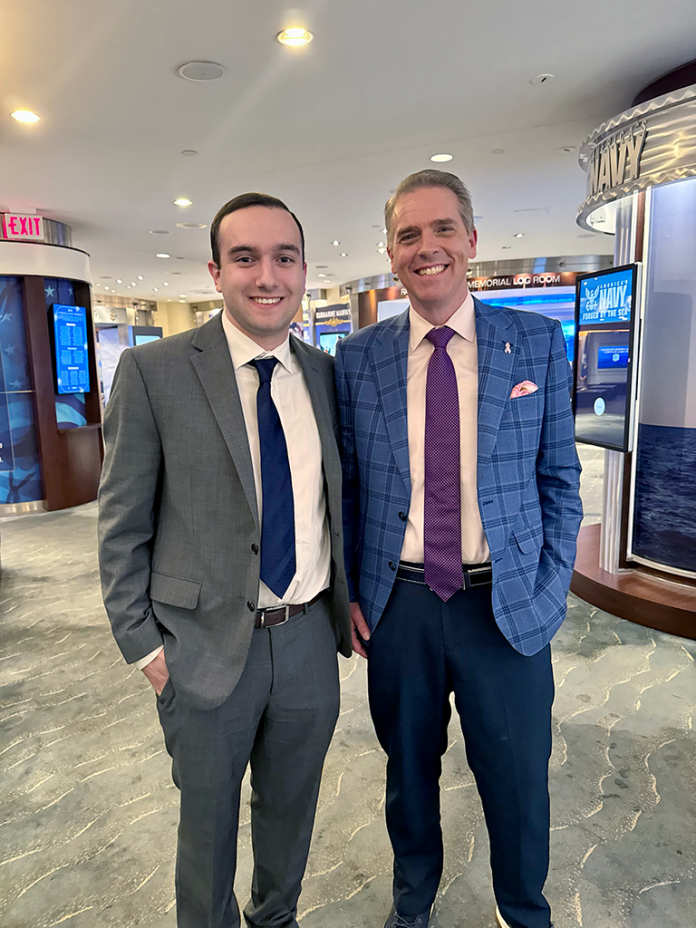
“With CNN … the reason it’s [10 p.m. show] doing well, it’s because people like to hear people argue and debate. I mean, it gets off the rails sometimes, but that’s OK, Americans get off the rails sometimes. …
“We have to get comfortable again, as a country, with arguing with each other. It’s OK if we disagree. It’s perfectly fine if we disagree. We’re Americans, we’re allowed to disagree. We have a right to disagree.
“And so if they’re making a movie where people can go out and disagree about the meaning of it and, ‘This is good, this is bad.’ I think that’s amazing, that’s a good thing. We’re not siloed off with just people and ideas that don’t challenge … our world.”
Animal Farm boasts a star-studded voice cast, and recruiting came easily as many of the actors “loved the book,” Serkis said during the fireside chat. He cited Seth Rogen, Glenn Close, Woody Harrelson, Gaten Matarazzo, Kathleen Turner, Steve Buscemi, and Laverne Cox, among many others.
The $30 million film was produced by Adam Nagle and Dave Rosenbaum for Aniventure and Cavendish for Imaginarium Studios, with animation from Cinesite.
ANDY SERKIS: MY VERSION OF ANIMAL FARM HAS SPARKED ROBUST DEBATE. ORWELL WOULD HAVE APPROVED
To wrap up the fireside chat, Jennings asked Serkis and Cavendish if they had any final words for viewers of Animal Farm before watching it. Serkis laughed as Cavendish said, “Have a great time and argue afterwards.”
Animal Farm will be released in theaters on Friday, May 1, through Angel Studios.