
Canadians have boycotted traveling to the United States for more than a year, but new tourism data compiled by the Canadian government show more are choosing to head south of the border.
May marked the second consecutive month since before President Donald Trump returned to office that more Canadians traveled to the U.S. than in the same month of the previous year, a sign that the long-term feud over tariffs and bilateral relations may be easing.
Last month, 1.95 million Canadians returned by automobile and airplane from the U.S., up nearly 10% from a year earlier, according to a June 11 release from government website Statistics Canada. The growth was largely due to a 15% increase in automobile travel.

However, last month’s 1.95 million visits were still 29% lower than the number of Canadians who traveled here in May 2024.
The bilateral fallout
For years, the U.S. has been the No. 1 destination for Canadian travelers because of its warmer climate and proximity. In 2024, 75% of all Canadians who traveled globally visited the U.S., roughly 39 million, according to government statistics.
In late 2024, Trump began to float the idea of Canada becoming the 51st U.S. state. Then-Canadian Prime Minister Justin Trudeau pushed back, describing the proposal as a nonstarter.
However, in February 2025, Trump said Canada’s becoming America’s newest state was the only way it could get around forthcoming tariffs.
Additionally, Trump’s immigration crackdown at the border led to more headlines about foreign travelers, including Canadians, being taken into custody or barred from entry when attempting to fly into the U.S.
Travel, moving forward
Trump’s February 2025 demands created a stand-off between countries. Pew Research Center polling from last February revealed Canadians’ views of the U.S. dropped to all-time lows. Those unfavorable views translated to a sharp decline in Canadian tourism.
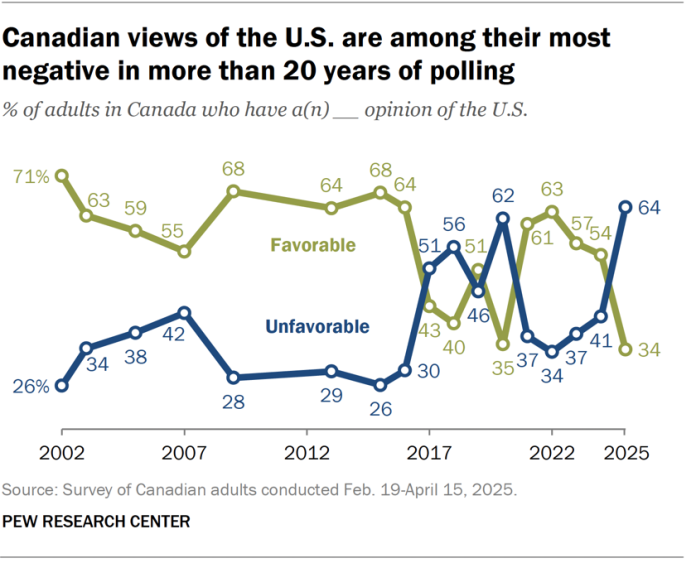
Last year, Canadian tourism to the U.S. dropped 25%. The U.S. Travel Association estimated that even a 10% decline in Canadian tourism would trigger the loss of 140,000 U.S. jobs and $2.1 billion in spending losses.
Over the past 15 months, Canada’s relationship with the U.S. has been less of an issue in the news and has just recently begun to turn a corner.
A survey conducted in March revealed that Gen Z Canadians are the ones bucking the yearlong boycott to visit America.
A March survey conducted by the Harris Poll for the Travel Health Insurance Association of Canada found that 45% of Gen Z residents planned to travel to the U.S. in the coming 12 months, as opposed to baby boomers, of which just 8% cited similar plans.
“We’re seeing a clear generational split among Canadians as they consider both their political views and economic conditions when planning travel,” THIA spokesman Will McAleer said in a statement to Travel Industry Today. “Despite ongoing political tensions, younger Canadians still show strong interest in travel to the U.S., instead citing rising costs as their biggest barrier to travel.”
Not all Canadians have come around. An April survey conducted by travel research consultants at Longwoods International’s Ontario and Ohio global headquarters found that more than half of Canadians cited U.S. government policies, trade practices, and political statements as making them less likely to visit the U.S. in the next year.
“Of those Canadians whose travel is being influenced by U.S. policies, 35% are replacing their trip to the U.S. with travel in Canada, 25% will go to another international destination and 13% will cancel their trip,” Longwoods International wrote in a report. “Among those replacing the U.S. with other international travel, Europe remains the top alternative, followed by Mexico and Asia.”
HOUSE DEMOCRATS HEAD TO NEW JERSEY FOR FORUM ON ICE’S DELANEY HALL DETENTION FACILITY
Canada’s prime minister, Mark Carney, recently applauded Canadians for holding out.
“Canadians have been keen to do their bit effectively — buy Canadian, visit their country,” Carney said in early May while speaking at a political conference.