
Support Joe’s Work
EXCLUSIVE: War for Fusion – From Iran’s Front Lines to a Boston Scientist’s Murder
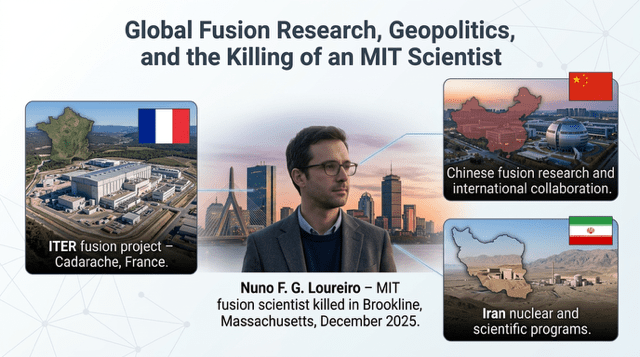
War for Fusion: From Iran’s Front Lines to a Boston Scientist’s Murder
Guest post
“BLOOD, FUSION, and POWER” asked whether the Brown University mass shooting and the killing of MIT fusion scientist Nuno Loureiro were random crimes or signs of a bigger battle over fusion. This battle is really about who will control future energy and military power, and why those choices are being made far away from the American people.
Under Barack Obama, the United States quietly moved tens of billions of dollars in funding, equipment, and scientific work toward the France based ITER fusion project and away from American labs, weakening U.S. facilities while feeding a foreign run “global collaboration.” Even some Democrats and budget experts warned that ITER was turning into a money pit that trapped U.S. fusion funding inside a structure controlled overseas. Taxpayers were never plainly told that money meant for American labs and jobs was being shifted so a multinational body in southern France could decide how it would be spent.
France sells ITER as a peaceful science and climate project, but it is also a tool of French power. Hosting the world’s flagship fusion experiment makes France the gatekeeper of a critical energy technology. China is an official partner, shipping giant components to the French site and embedding its engineers there while using what they learn to boost their own “artificial sun” projects at home. Iran, although blocked from formally joining ITER by a U.S. veto, has locked itself into a sweeping 25 year strategic deal with China covering energy and technology, and has sought scientific cooperation with Europe in nuclear adjacent fields. On paper, ITER is neutral; in reality, France, China, and Iran are tied together through energy, technology, and strategy. The current war involving Iran’s proxies only underlines the point. Any serious solution has to look at those backing and supplying Tehran, not just the fighters on the ground.
This creates a sharp problem inside NATO. France enjoys the full benefits of the alliance and American security guarantees, yet hosts a fusion project closely tied to Chinese industry and sits in a European environment that looks for ways to keep trade and energy links with Iran alive. How can a country claim to protect NATO and U.S. interests while deepening its energy and technology ties to Beijing and standing at the center of a system that helps the very powers arming Iran’s war?
At the same time, there are still no clear answers about why someone killed one of America’s top fusion scientists. Police and media reports identify the suspected gunman, Claudio Manuel Neves Valente, a former Brown physics student later found dead in an apparent suicide, as the man likely responsible for both the Brown University shooting and Loureiro’s killing. Yet officials have not provided a convincing motive and have said they have no public evidence linking the attack directly to Loureiro’s research. The official story stops right where the real questions begin, and what the public is being asked to accept, without full explanation, does not make sense.
All of this unfolded as President Donald Trump pushed in the opposite direction, toward bringing fusion power and investment back under American control. In 2025, his administration advanced an “America First” investment and industrial approach, tightening focus on strategic sectors such as advanced energy and technology and supporting moves toward a national fusion roadmap aimed at a strong domestic industry.
Then, in mid December 2025, a tight sequence hit. Between December 13 and 18, the Brown engineering school was attacked, Loureiro was shot and later died, the suspected shooter was found dead, and Trump Media and Technology Group, owner of Truth Social, announced a merger valued at more than six billion dollars with private fusion firm TAE Technologies in order to place a major U.S. fusion player under its umbrella. Within five days, a key piece of America’s fusion brain trust was hit, the alleged attacker was gone, and a Trump aligned vehicle moved to consolidate a flagship U.S. fusion company. It is hard to miss the implications.
Here was our post on it at the time:
A president was reanchoring fusion capital and leadership at home, a leading scientist was killed with no clear motive, and a highly visible business move challenged the international fusion structure that favors France, China, and their partners. Yet instead of a full national security and counter-intelligence review, Loureiro’s death has been handled mainly as a local crime, not as a possible case of foreign influence or sabotage.
France insists ITER is a “peaceful” climate project, but the technology and data inside it are dual-use and sit close to modern weapons and defense systems. High field magnets, advanced materials, power electronics, and plasma control software are just as important for directed energy weapons, hardened command centers, hypersonic platforms, and AI-driven defense networks as they are for power plants. China’s official role in ITER and Iran’s deep reliance on Chinese energy and technology deals mean a NATO state is effectively hosting a strategic military toolkit in which Beijing is inside the room and Tehran benefits through its partners. In that environment, President Trump appears to be dealing with “allies” who speak of peace and cooperation while quietly double dealing, taking U.S. protection with one hand and deepening ties to China and Iran with the other.
Over all of this hangs Big Tech. Major technology companies that dominate data, online speech, and digital payments are also investing in fusion through stakes in start ups, artificial intelligence and control software, and cloud services. To the public, it looks like innovation. Underneath, it is about control. The same firms that can mute or boost voices online are positioning themselves to shape who gets energy, when, and on what terms once fusion comes online.
This no longer looks like a simple science project. It looks like the core of a new cartel. France hosts and manages it. China supplies and learns from it. Iran gains indirectly through its partnerships with those players. Big Tech waits to tie it all together through software and data. The people left out are the taxpayers who financed it and whose safety depends on how it is used.
Fusion is often called “bottling the sun.” Whoever controls that bottle will influence industry, technology, and war. Right now, that bottle is being built in France, deeply tied to Chinese and Iranian interests, while Americans, including many Democrats who raised concerns about ITER’s cost and offshoring, still lack a clear accounting of what was done in their name. The choice is stark. Either this entire arrangement is brought into the open and the killing of a leading U.S. fusion scientist is treated with the seriousness of a possible espionage case, and real national control is restored, or a small group of governments and corporations, some inside NATO and some aligned with Iran and China, will continue a quiet war for fusion while the public pays the price in the dark.